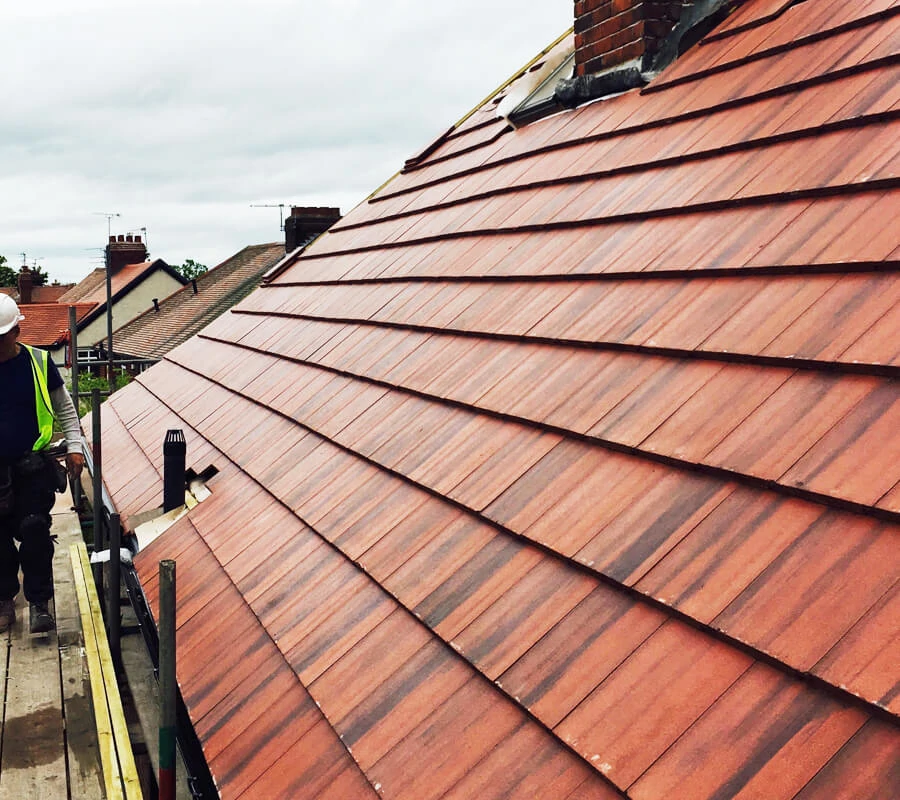





When installing a new or replacement roof, our roofers know the importance of fitting underlay. Installed beneath a roof’s tiles or slates, the underlay will continuously guard against wind uplift as well as help to catch wind-driven rain, snow or dust that gets past the tiled or slated covering.
You should be careful not to underestimate the pressure which wind can put on a roof; indeed, the underlay’s wind uplift resistance requirements are enshrined in the British Standard 5534:2014.
What is the British Standard 5534:2014?
Don’t worry, we will try not to descend into overly technical language here. However, we will attempt to summarise the recommendations and stipulations in BS 5534:2014, including the advice that underlay should always be used beneath tiles and slates on a roof.
This British Standard also cites the five wind zones into which the UK is divided. These wind zones provide an overview of how wind strength differs between particular parts of the UK, so a roofer may need to determine that they are using underlay suitable to the applicable zone.
When does a roofer need to think about wind zone suitability?
There are only particular situations where a roofer would need to assess whether the underlay they are using is suitable for use in the local wind zone. However, our own roofers always watch out for the following criteria when deciding what type of underlay to apply…
Is there a continuous ceiling? Does the ridge height exceed 15m? Is the roof pitch between 12.5° and 75° degrees? Does the site altitude surpass 100m? Is the site not over halfway up a hill or escarpment/cliff with a gradient of over 5%? If the answer to all of these questions is “yes”, then BS 5534:2014 requires the roofer to consider the underlay’s wind zone suitability.
This is not necessarily an entirely straightforward task, as an RCI article warns: “Some underlays will only be compliant with certain zones”. Hence, if a roofer is uncertain whether a particular underlay is suitable for use in a specific zone, they should check with the manufacturer.
Do other wind uplift resistance requirements apply?
Yes; for example, the relevant batten gauge’s wind uplift resistance must equal or surpass the calculated design wind pressure on the underlay, keeping in mind how this underlay will be specifically applied on-site.
There are various types of underlay; though the main two are high water vapour resistance (HR) and low water vapour resistance (LR), subcategories of the latter include airtight, air-permeable and air-open underlays.
However, the important thing is that, whatever the type of underlay, it comes with a zonal classification label. This will make the underlay compliant with BS 5534 – and, whether you talk to our roofers in Sunderland, Hartlepool, Darlington, Chester-le-Street or any other North East area, they can discuss the varying options with you.
Explore Our North East Roofing Services